الخميس، 16 يونيو 2016

Naozlanda pound


Naozlanda pound achieves 300 points so far
Expectations since Aodat my recommendations of the Group, I think the percentage multiplied 90 per hundred Bmsthdvat not less than 100 points clear results completely if should learn systems and Balash filled Venkoh I mean Alastregih who at the end of a loser in or outside the neutral Belaavah I think Charata will not see anywhere in the world is the name of Abou Alam adviser I hope that you explain it and become a professional analyst, but distinct from the others

Technical Analysis


Technical Analysis
GOLD
The general trend upward today, targeting 1288/94 then we start landing operations 1265-1252
In the case of the closure of a candle hours the highest level in 1294, it is possible to complete the climb in 1311
# EURUSD
The general trend upward to an area 1.1300
In the case of the closure of a candle hour down the level of 1.1235
It is possible drop to 1.1198 - 1.1136

Daily Analysis


ieved the target yesterday at 1.1198

As for today's trading, it is possible to continue the downward trend to 1.1198 - 1.1136
In the case of the rise of the price and the closing hour candle highest level 1.1240, it is possible to engage in PPC operations to 1.1300- 1.1365
# USDCHF
The general trend is to the downside from current levels to 0.9566
In the case of the closure of a candle hours the highest level 0.9675, it is possible to climb to 0.9745
# GOLD
The general trend is to the downside today we are targeting 1265 - 1252
In the case of the closure of a candle hours the highest level in 1289, it is possible to complete the climb in 1311
# GBPUSD
I think the general trend for the Pound dollar bearish day of the current levels
To 1.3980 levels
But in the event of closure of an hour candle above 1.4250
It is possible to climb to 1.4454
# GBPUSD
I think the general trend is bearish for the pound dollar today from current levels to 1.3980 levels in the event of either a candle closing hours the highest level 1.4225, it is possible to climb to 1.4454

mesothelioma


نتيجة بحث الصور عن ‪mesothelioma‬‏


Did you know that doctors diagnose an estimated 3,000 cases of mesothelioma annually in the U.S.? The majority of those are traced to job-related exposures to asbestos. Most people have the pleural type, which forms on the lining of the lungs, but the cancer can also form around the lining of the abdomen or heart.
Although asbestos use in this country has dropped in recent decades, a steady number of people are still getting mesothelioma. That's because this cancer can take anywhere from 20 to 50 years after asbestos exposure before symptoms appear, and an oncologist can make a definitive diagnosis.
While there's no cure for mesothelioma and the outlook is generally poor, researchers have made significant progress in understanding the cancer and developing new treatment options and alternative therapies.

How Does Asbestos Cause Cancer?

Mesothelioma typically develops after people are exposed to asbestos in the workplace – in industrial settings, shipyards, auto repair shops, old houses, schools and public buildings. While it usually takes long-term exposure to put someone at risk, short-term and one-time exposures are also known to cause this cancer.
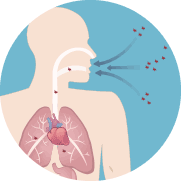
Body Inhaling Asbestos
Asbestos inhalation occurs
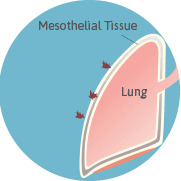
Asbestos Fibers lodging in the mesothelial tissue
Fibers lodge in mesothelial tissue
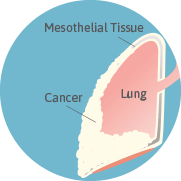
 Asbestos Fibers in the mesothelial tissue
Fibers cause cellular damage, resulting in tumor growth
Fast Fact: 70-80 percent of people with mesothelioma were exposed to asbestos at work.
Asbestos can cause health complications when work duties or other activities disturb asbestos-containing materials and release fibers into the air. When we inhale or swallow these microscopic fibers, our bodies struggle to get rid of them. Over decades, the trapped fibers trigger biological changes that can cause inflammation, scarring and genetic damage that sometimes leads to cancer. The lengthy gap between asbestos exposure and diagnosis is called the latency period.
Asbestos fibers most often become trapped in the lining of the lungs, called the pleura. They also can collect in the lining of the abdominal cavity (peritoneum) or heart (pericardium). Once fibers cause biological damage, the stage is set for the decades-long latency period for the development of malignant mesothelioma.

drug rehab


نتيجة بحث الصور عن ‪drug rehab‬‏


What is drug addiction?

Drug addiction is a chronic disease characterized by compulsive, or uncontrollable, drug seeking and use despite harmful consequences and changes in the brain, which can be long lasting. These changes in the brain can lead to the harmful behaviors seen in people who use drugs. Drug addiction is also a relapsing disease. Relapse is the return to drug use after an attempt to stop.

Addiction is a disease that affects both the brain and behavior.
The path to drug addiction begins with the voluntary act of taking drugs. But over time, a person's ability to choose not to do so becomes compromised. Seeking and taking the drug becomes compulsive. This is mostly due to the effects of long-term drug exposure on brain function. Addiction affects parts of the brain involved in reward and motivation, learning and memory, and control over behavior.

Can drug addiction be treated?

Yes, but it’s not simple. Because addiction is a chronic disease, people can’t simply stop using drugs for a few days and be cured. Most patients need long-term or repeated care to stop using completely and recover their lives.
Addiction treatment must help the person do the following:
  • stop using drugs
  • stay drug-free
  • be productive in the family, at work, and in society 

Principles of Effective Treatment

Based on scientific research since the mid-1970s, the following key principles should form the basis of any effective treatment program:
  • Addiction is a complex but treatable disease that affects brain function and behavior.
  • No single treatment is right for everyone.
  • People need to have quick access to treatment.
  • Effective treatment addresses all of the patient’s needs, not just his or her drug use.
  • Staying in treatment long enough is critical.
  • Counseling and other behavioral therapies are the most commonly used forms of treatment.
  • Medications are often an important part of treatment, especially when combined with behavioral therapies.
  • Treatment plans must be reviewed often and modified to fit the patient’s changing needs.
  • Treatment should address other possible mental disorders.
  • Medically assisted detoxification is only the first stage of treatment.
  • Treatment doesn't need to be voluntary to be effective.
  • Drug use during treatment must be monitored continuously.
  • Treatment programs should test patients for HIV/AIDS, hepatitis B and C, tuberculosis, and other infectious diseases as well as teach them about steps they can take to reduce their risk of these illnesses.

How is drug addiction treated?

Successful treatment has several steps:
  • detoxification (the process by which the body rids itself of a drug)
  • behavioral counseling
  • medication (for opioid, tobacco, or alcohol addiction)
  • evaluation and treatment for co-occurring mental health issues such as depression and anxiety
  • long-term follow-up to prevent relapse
A range of care with a tailored treatment program and follow-up options can be crucial to success. Treatment should include both medical and mental health services as needed. Follow-up care may include community- or family-based recovery support systems.

How are medications used in drug addiction treatment?

Medications can be used to manage withdrawal symptoms, prevent relapse, and treat co-occurring conditions.
Withdrawal. Medications help suppress withdrawal symptoms during detoxification. Detoxification is not in itself "treatment," but only the first step in the process. Patients who do not receive any further treatment after detoxification usually resume their drug use. One study of treatment facilities found that medications were used in almost 80 percent of detoxifications (SAMHSA, 2014).
Relapse prevention. Patients can use medications to help re-establish normal brain function and decrease cravings. Medications are available for treatment of opioid (heroin, prescription pain relievers), tobacco (nicotine), and alcohol addiction. Scientists are developing other medications to treat stimulant (cocaine, methamphetamine) and cannabis (marijuana) addiction. People who use more than one drug, which is very common, need treatment for all of the substances they use.
  • Opioids: Methadone (Dolophine®, Methadose®), buprenorphine (Suboxone®, Subutex®), and naltrexone (Vivitrol®) are used to treat opioid addiction. Acting on the same targets in the brain as heroin and morphine, methadone and buprenorphine suppress withdrawal symptoms and relieve cravings. Naltrexone blocks the effects of opioids at their receptor sites in the brain and should be used only in patients who have already been detoxified. All medications help patients reduce drug seeking and related criminal behavior and help them become more open to behavioral treatments.
  • Tobacco: Nicotine replacement therapies have several forms, including the patch, spray, gum, and lozenges. These products are available over the counter. The U.S. Food and Drug Administration (FDA) has approved two prescription medications for nicotine addiction: bupropion (Zyban®) and varenicline (Chantix®). They work differently in the brain, but both help prevent relapse in people trying to quit. The medications are more effective when combined with behavioral treatments, such as group and individual therapy as well as telephone quitlines.
  • Alcohol: Three medications have been FDA-approved for treating alcohol addiction and a fourth, topiramate, has shown promise in clinical trials (large-scale studies with people). The three approved medications are as follows:
    • Naltrexone blocks opioid receptors that are involved in the rewarding effects of drinking and in the craving for alcohol. It reduces relapse to heavy drinking and is highly effective in some patients. Genetic differences may affect how well the drug works in certain patients.
    • Acamprosate (Campral®) may reduce symptoms of long-lasting withdrawal, such as insomnia, anxiety, restlessness, and dysphoria (generally feeling unwell or unhappy). It may be more effective in patients with severe addiction.
    • Disulfiram (Antabuse®) interferes with the breakdown of alcohol. Acetaldehyde builds up in the body, leading to unpleasant reactions that include flushing (warmth and redness in the face), nausea, and irregular heartbeat if the patient drinks alcohol. Compliance (taking the drug as prescribed) can be a problem, but it may help patients who are highly motivated to quit drinking.
  • Co-occuring conditions: Other medications are available to treat possible mental health conditions, such as depression or anxiety, that may be contributing to the person’s addiction

search engine marketing

نتيجة بحث الصور عن ‪search engine marketing‬‏


Revolutionize Your Internet Marketing
Leverage today's Internet marketing strategies to reach customers, increase sales, and establish performance-based marketing in your organization. Search Engine Marketing explains how to use Web analytics, key performance indicators (KPIs), search engine optimization (SEO), and search marketing-the critical tools for success. Multichannel marketing, which uses radio, TV, and print to broadcast your message, is also covered. The book includes revealing interviews with industry experts as well as valuable tips on vendor selection. Implement an effective, integrated marketing program for your business with help from this definitive guide. 
  • Track and measure both digital and traditional marketing with analytics
  • Define and use KPIs to manage campaigns and channels for maximum profitability
  • Employ SEO strategies to increase leads, conversions, and sales
  • Understand how website architecture, keywords, tags, and sitemaps affect search results
  • Use PPC to place ads in search engines, radio, TV, and newspapers
  • Get hands-on strategies for maximizing Google Analytics and Google AdWords

Table of contents
Foreword
Acknowledgments
Introduction
Chapter 1. Integrated Marketing
Chapter 2. KPIs
Chapter 3. Analytics
Chapter 4. Google Analytics
Chapter 5. SEO
Chapter 6. PPC
Glossary
Index

cerebral palsy

Cerebral Palsy


Cerebral palsy (CP) is a disorder that affects muscle tone, movement, and motor skills (the ability to move in a coordinated and purposeful way).
CP usually is caused by brain damage that happens before or during a baby's birth, or during the first 3 to 5 years of a child's life. This brain damage also can lead to other health issues, including vision, hearing, and speech problems; and learning disabilities.
There is no cure for CP, but treatment, therapy, special equipment, and, in some cases, surgery can help kids who are living with the condition.

About Cerebral Palsy

Cerebral palsy is one of the most common congenital (existing at or before birth) disorders of childhood. About 500,000 children in the United States have the condition.
The three types of CP are:
  1. spastic cerebral palsy — causes stiffness and movement difficulties
  2. athetoid cerebral palsy — leads to involuntary and uncontrolled movements
  3. ataxic cerebral palsy — causes a problem with balance and depth perception
Since cerebral palsy affects muscle control and coordination, even simple movements — like standing still — are difficult. Other functions that also involve motor skills and muscles — such as breathing, bladder and bowel control, eating, and talking — also may be affected when a child has CP.
Cerebral palsy does not get worse over time.

Causes of Cerebral Palsy

The exact causes of CP aren't always known. But many cases are the result of problems during pregnancy when a fetus' brain is either damaged or doesn't develop normally. This can be due to infections, maternal health problems, a genetic disorder, or something else that interferes with normal brain development. Rarely, problems during labor and delivery can cause CP.
Premature babies — particularly those who weigh less than 3.3 pounds (1,510 grams) — have a higher chance of having CP than babies that are carried to term. So do other low-birthweight babies and multiple births, such as twins and triplets.